"I'm using hydrating products — so why doesn't my skin feel healthy?" Because hydration and skin health are not the same thing.
You're doing everything right. Hydrating serums. Moisturisers. Oils. Your skin should feel good. But something still feels off — maybe it's still dry, or inconsistent, or just not as balanced and strong as you expected.
The confusion starts here: hydration and skin health are routinely treated as the same thing. Add enough water content and the skin will be healthy. But this assumption misses something fundamental — and it explains why so many people feel like they're doing everything correctly and still not getting the result they want.
Water in the skin
Hydration refers to the water content of skin cells and the spaces between them. It can be temporarily increased by applying humectants, occlusives, and water-binding ingredients. When hydration is adequate, skin feels plump, comfortable, and supple.
Important — but only part of the picture. You can have adequate hydration and still have skin that doesn't function well.
What your skin does with that water
Skin function refers to how effectively the skin retains, regulates, and responds to hydration — and to everything else it manages. It is determined by cellular signalling, lipid architecture, responsiveness, and regulation. These are the processes that make hydration effective.
This is what determines whether hydration works — and whether it lasts.
The difference matters more than most people realise. Because it explains the gap between what's being applied and what's actually being experienced — and it points toward a fundamentally different approach to addressing it.
What Skin Function Actually Requires
For hydration to actually work — to be absorbed, retained, and used effectively by the skin — four things need to be functioning properly. These aren't optional extras. They're the prerequisites for hydration to do anything meaningful beyond a brief surface effect.
Lipid Architecture
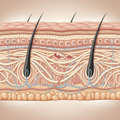
Holds water in placeThe structured layer of lipids between skin cells forms a physical seal that prevents water from escaping. When this architecture is compromised — through age, barrier disruption, or chronic inflammation — moisture leaves the skin faster than it can be replenished. Adding more hydration doesn't repair the architecture.
Cellular Signalling
Manages repair and balanceThe skin's cells use chemical signals to coordinate hydration balance — deciding how much water to retain, when to repair barrier function, and how to respond to environmental stress. When signalling is clear, hydration is actively managed. When it's disrupted, regulation becomes inconsistent.
Responsiveness
Reacts to what you applyThe skin's ability to recognise and respond to external inputs — including the hydrating products you apply. Declining responsiveness means even well-formulated hydrating products produce diminishing returns, because the skin is less able to act on the signals they send.
Regulation
Maintains stability over timeThe skin's ongoing ability to maintain hydration balance without constant external intervention. When regulation is functioning, the skin self-corrects — adjusting to environmental changes, temperature, stress, and other variables that constantly challenge its balance.
"Without these four things working together, water goes in — but it doesn't stay. Or it doesn't get used properly. Or it creates only a temporary effect."
What Happens When Function Is Off — Three Predictable Patterns
When skin function is compromised, three predictable patterns tend to emerge. Each looks like a hydration problem — but each has a functional cause that hydration alone can't address.
Water goes in — but doesn't stay
Humectants draw water to the skin's surface, but compromised lipid architecture allows it to escape quickly. The skin feels hydrated immediately after application — and dry again within hours.
The solution is not more frequent application. It's supporting the structure that holds moisture in.
Water goes in — but doesn't get used properly
Cellular signalling disruption means the skin can't coordinate its use of available water for repair, regulation, and balance. Hydration levels may be adequate, but the skin can't direct that resource where it's needed.
The skin feels paradoxically dry and overloaded at the same time — greasy surface, tight underlying layers.
Water creates improvement — but only temporarily
Declining responsiveness and regulation means the skin can't sustain the improvement that hydrating products create. Results appear briefly — and then fade as the skin reverts to its baseline function level.
This is the pattern described in Blog 4 — real results that don't hold because the baseline function hasn't changed.

Hydration and skin function are related — but distinct. You can have one without the other, which is why applying more hydrating products doesn't always produce a healthier skin.
Why "Just Add More Hydration" Doesn't Work
The conventional response to dry or dull skin is to add more hydration — a richer moisturiser, a hydrating serum underneath, a sleeping mask on top. And sometimes this helps, temporarily. But it rarely solves the underlying problem, for a straightforward reason.
"You can be 'hydrated' and still not feel like your skin is truly healthy. Because health isn't just input. It's function."
Adding more hydrating ingredients increases input. But if the skin's ability to retain, regulate, and respond is compromised, additional input doesn't improve the outcome — it just requires more maintenance to sustain the same temporary result.
The Input vs Function Distinction
Most approaches to hydration focus on what goes in. The more productive question is what the skin can do with what it receives.
Add more hydration
Apply richer formulas, more layers, more frequent application. Addresses the symptom directly — but doesn't change the skin's ability to retain or regulate what it receives. Results require constant maintenance.
Support how hydration works
Address the lipid architecture, signalling, responsiveness, and regulation that determine what the skin does with hydration. Improves outcomes progressively — the skin becomes better at managing what it receives.
This doesn't mean hydrating ingredients are irrelevant — they're essential. But their effectiveness is conditional on the skin's functional capacity. And that's what most hydration-focused approaches don't address.
How This Connects to the Broader Picture
This article is the fifth in a series exploring why skin doesn't always respond the way it should — and what's actually happening when it doesn't. Each article has approached the same underlying truth from a different angle:
- Blog 1 — Most moisturisers don't fix dry skin because they address surface hydration, not the system that retains it
- Blog 2 — Skin stops responding over time because its signal loop weakens — not because products stop working
- Blog 3 — Cellular communication is the process that coordinates every aspect of skin behaviour, including hydration
- Blog 4 — Results fade because the skin's baseline function hasn't changed — temporary improvement reverts without functional support
The hydration-function distinction is the clearest expression of this pattern. It isolates the core question: are you addressing what goes into the skin, or what the skin can do with it?
Function Determines Whether Hydration Works
Skin that functions well retains hydration naturally, regulates it efficiently, and responds predictably to what you apply. Skin that functions poorly struggles to hold moisture regardless of how much is applied — because the systems responsible for retention and regulation are not operating at full capacity.
Supporting function is not an alternative to hydration. It's what makes hydration effective.
The Mabel Gray Approach — Both, Together
The Mabel Gray system is built around a simple principle: hydration and function are not alternatives — they work together, and both are needed. The question is which to address first, and how.
The answer the system is built around: function first, hydration supported by it.
- The Advanced Boost Serum supports signalling and responsiveness — improving how the skin receives and acts on inputs, including hydration
- The Intensive Hydration Moisturiser reinforces lipid architecture and supports the regulatory environment — the conditions that allow hydration to be retained and used effectively

The serum supports how the skin responds. The moisturiser supports the environment where that response — and hydration retention — occurs. Together, they address both input and function.
When function improves, hydration finally starts to behave the way it should. The skin holds moisture more consistently. Results don't require constant reapplication. And improvement builds rather than plateaus — because the underlying system is sustaining it, not just the product sitting on top.
"When function improves, hydration finally starts to behave the way it should. The skin holds — and the results hold with it."