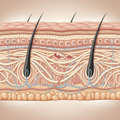
It sounds scientific. It sounds important. But it also feels vague — so what is your skin actually communicating, and why does it matter?
"Cellular communication." It's one of those phrases that sounds important — and also a little opaque. You might have encountered it in skincare marketing, or in an explanation of why a product works. But what does it actually mean for your skin, day to day?
The simplest way to understand it: your skin is constantly sending messages. Between cells. Between layers. Across systems. Every second, something is being decided.
Should we repair?
Cells communicate damage signals — triggering repair cycles that restore structure and function.
Should we hold moisture?
Hydration balance is actively managed — not passive. Signals determine how much water the skin retains.
Should we calm inflammation?
Inflammatory responses are regulated by signals — too much causes damage, too little slows repair.
Should we protect or regenerate?
The balance between protection and regeneration shifts constantly — driven by the signals cells exchange.
All of that happens through signals — a constant, rapid, invisible conversation between cells. And when those signals are clear, the skin works the way it's supposed to: adapting, adjusting, maintaining itself without constant external intervention.
What the Signals Actually Are
Cellular communication in skin happens through several biological mechanisms — each playing a distinct role in how the skin coordinates its behaviour.
Chemical Messengers — Cytokines and Growth Factors
Skin cells release molecules called cytokines and growth factors that act as chemical instructions. These molecules travel between cells and trigger specific responses — initiating repair, regulating inflammation, or signalling that collagen production is needed.
When production of these messengers declines — or when cells become less sensitive to them — the instructions become quieter. The skin still tries to respond, but does so less efficiently, less completely, and less predictably.
The Lipid Environment — Where Signals Travel
Chemical signals don't travel through empty space. They move through the lipid matrix — the structured layer of fats that sits between skin cells and forms the basis of what we call the skin barrier.
This is why the lipid environment matters beyond simple moisture retention. It's the medium through which cellular communication occurs. When the lipid structure is compromised — through barrier disruption, age, or chronic inflammation — signals become harder to transmit clearly. The conversation between cells gets noisier, and responses suffer.

The lipid matrix between skin cells is not just a moisture barrier — it's the medium through which cellular signals travel. Disruption to this environment affects the clarity of communication, not just water retention.
Gap Junctions — Direct Cell-to-Cell Connection
Some cellular communication happens directly — through protein channels called gap junctions that allow adjacent cells to exchange molecules and electrical signals almost instantaneously. This type of communication is critical for coordinating responses across large areas of skin, ensuring that repair and regulation happen in a organised, synchronised way rather than in isolated patches.
"Your skin isn't just reacting to the outside world. It's running a continuous internal conversation — coordinating millions of decisions every second."
What Miscommunication Looks Like on the Surface
When cellular communication is working well, the results are visible in how the skin behaves — consistent hydration, even tone, efficient recovery from stress, and predictable response to products. When it starts to break down, the visible effects are equally recognisable.
When Signals Break Down — What You See
Persistent dryness
Signals controlling hydration retention become less clear. The skin struggles to hold moisture even when sufficient water is applied externally.
Increased sensitivity and reactivity
Inflatory regulation falters. Minor triggers produce disproportionate responses — redness, irritation, or prolonged discomfort after products that were previously tolerated.
Slow or incomplete recovery
Repair signals are delayed or incomplete. Skin that was once resilient takes noticeably longer to recover from minor stress, friction, or environmental exposure.
Inconsistent product results
Products that once worked reliably start to deliver unpredictable outcomes. The same formula, the same routine — but different results. The issue is responsiveness, not the formula.
What connects all of these is not a single cause, but a single pattern: the skin's internal coordination is less effective. Messages are being sent — but they're not getting through clearly, or not being acted on efficiently.
"So many skin issues aren't just about damage. They're about miscommunication — messages not being sent clearly, or not being received at all."
Why This Changes the Skincare Equation
Once you understand skin as a communication system, the dominant approach to skincare starts to look different.
Most skincare products are designed to do something to the skin from the outside — add moisture, stimulate collagen, exfoliate dead cells. These inputs have value. But their effectiveness depends entirely on whether the skin can recognise and respond to them.
A product that sends a signal for collagen production is only as effective as the skin's ability to receive that signal and act on it. A moisturiser that deposits water at the surface is only as effective as the skin's ability to retain and regulate that water internally.
Product Applied
Signal is sent to the skin
Signal Received
Cell recognises the input
Response Triggered
Repair, hydration, or balance is initiated
Result Maintained
System sustains the improvement
When communication is clear, this chain completes efficiently. When signals are disrupted at any point, results become inconsistent — regardless of the quality of the product applied.
This is why the Mabel Gray approach focuses on the communication environment itself — not just what is applied to the surface. When the signals are clear and the environment supports transmission, every product you use — not just Mabel Gray — becomes more effective.
How Communication Can Be Supported
Modern skincare science increasingly recognises that the skin's signalling environment is not fixed. It can be disrupted — but it can also be supported, and to a significant degree, restored.
Supporting cellular communication means addressing the conditions that allow it to happen effectively:
- The lipid environment — maintaining the structural integrity of the medium through which signals travel
- Signalling pathway support — providing the biological inputs (peptides, specific actives) that support clear cell-to-cell communication
- Reducing inflammatory noise — chronic low-grade inflammation disrupts communication and makes responses less predictable
- Antioxidant protection — oxidative stress degrades signalling molecules and the pathways they travel through

Supporting cellular communication is not about adding more active ingredients — it's about creating the conditions in which those signals can be sent, received, and acted upon effectively.
This is not about adding more ingredients to force a result. It's about creating the conditions in which the skin can coordinate itself again — the way it does naturally when the communication environment is intact.
What This Means Practically
Once you see it this way, the goal of a skincare routine shifts. It's no longer primarily about forcing change from the outside. It's about helping your skin coordinate itself again.
That shift changes what you look for in a product. Instead of asking "what does this do to my skin?" the more useful question becomes: "does this support the conditions my skin needs to function and respond properly?"
"When communication improves, everything else starts to fall back into place — hydration, recovery, consistency, and the effectiveness of everything you apply."
This is where the Mabel Gray system fits. Each formulation is designed around the idea that the skin's ability to communicate — to send and receive the signals that govern every aspect of how it looks and behaves — is the foundation on which everything else depends.
Not as a marketing concept. As a formulation principle — one that has been refined over decades of direct observation of how skin responds when that communication is supported versus when it isn't.

The Mabel Gray two-step system is built around the same principle explored in this article — that improving the skin's communication environment improves everything that depends on it.
How the Two Products Address Communication
The Advanced Boost Serum works at the signalling level — providing the peptides and actives that support clearer cell-to-cell communication and improve how the skin responds internally.
The Intensive Hydration Moisturiser supports the lipid environment — reinforcing the medium through which those signals travel, and ensuring the conditions for communication remain intact after the serum has done its work.
Together, they address both the signal and the environment it needs to function in.