If skin replaces itself, why does a scar remain?
We're often told that skin continually 'renews' itself.
Cells are produced in the deeper epidermis. They differentiate, migrate upwards, form the protective outer barrier and are eventually shed. New cells take their place. The process continues throughout life, although its speed and efficiency change with age.
Lovely. Except that this familiar little fact contains a rather large problem.
Is Longevity about the skin’s ability to stay healthy and functional over time?
Yes, Anti-aging is corrective, it suggests a defensive rear-guard action, so to speak. But skin longevity is preventive, aimed at protecting and supporting what you still have, and helps your skin do its own job better. The skin keeps replacing itself. But if skin keeps replacing itself, why doesn't a scar gradually disappear? Why does the new skin keep reproducing the evidence of an injury that may have happened decades ago?
That question helped trigger my own long inquiry into what healing and renewal actually mean.
Because if this standard replacement level renewal merely recreates the scar, then renewal alone isn't a restoration.
And if that's true of scarred skin, it forces us to look more carefully at what continual renewal can, and can not, mean for ageing skin.
Skin Doesn't Rebuild Itself From a Blank Blueprint
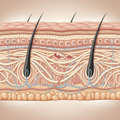
The popular description of skin renewal concentrates on epidermal turnover. But the skin is an organ, not a conveyor belt of keratinocytes.
Beneath the epidermis lies the dermis: fibroblasts, collagen, elastin, blood vessels, nerves, immune cells, glycosaminoglycans, appendages and an extracellular matrix that provides both physical support and biological information.
When skin is deeply injured, the body has an immediate priority. It must close the breach, prevent infection and restore mechanical strength. Perfect regeneration would be delightful, but survival is less fussy.
Fibroblasts and myofibroblasts move into action. They produce and organise extracellular matrix, contract the wound and replace missing architecture with scar tissue. The repair is fast and structurally useful, but it may restore integrity at the cost of full function. Collagen is arranged differently. Hair follicles, glands and other appendages may be absent. Mechanical stiffness and cellular behaviour may change.
The epidermis above can continue turning over perfectly obediently.
But it is renewing over altered ground.
New cells don't arrive in an empty space with instructions to recreate the skin exactly as it existed before the injury. They enter a tissue environment already shaped by the repair: its matrix, mechanics, cell populations and signalling history.
So the scar renews as the scar it has become.

The Matrix Is More Than Scaffolding
We once spoke of the extracellular matrix as though it were biological packing material: a passive frame holding the important cells in place.
It's nothing of the sort.
Cells attach to the matrix, pull against it and detect its stiffness, geometry and tension. Through mechanotransduction, physical forces are translated into biochemical signals. Those signals can influence cell survival, migration, differentiation, inflammatory behaviour and the production or breakdown of further matrix.
The cells shape the matrix.
And the matrix shapes the cells.
This reciprocal conversation can support healthy repair. But it can also stabilise an altered condition. A stiffer or disorganised matrix changes the mechanical information cells receive. Their changed behaviour can then maintain or deepen that matrix state.
The structure has become part of the message.
That is why the language of turnover is inadequate. It tells us that replacement is happening. It tells us very little about the quality, organisation or functional fidelity of what is being built.
Renewal in Kind
Ageing skin isn't simply scar tissue, and the two shouldn't be confused.
But the scar exposes a broader biological principle: renewal occurs inside the inherited conditions.
Older or chronically compromised skin continues to renew. Yet it may do so within a less supportive environment—one marked by altered barrier lipids, fragmented or cross-linked matrix, chronic inflammatory signalling, oxidative stress, glycation, cellular senescence, weaker dermal-epidermal communication and declining responsiveness to mechanical information.
The process continues, but the available conditions influence its output.
This gives us a phrase of considerable importance:
Renewal in kind.
Skin renewing within unsupported, compromised conditions may reproduce whatever level of decline has already become its working normal.
It is renewing, certainly.
But renewal isn't automatically rejuvenation.
Producing new keratinocytes doesn't, by itself, reorganise fragmented collagen, restore missing barrier lipids, remove accumulated cross-links, quiet every inflammatory signal or reconstruct the youthful dermal-epidermal junction.
The calendar hasn't instructed the skin to grow old. But accumulated conditions can progressively change what the skin is able to build, maintain and repair.

The Quality of Renewal
What does Longevity mean, in practice?
This is where the fashionable conversation about *skin longevity* needs to become considerably more precise.
If longevity means only that renewal continues, then almost every living skin already qualifies.
The real question is:
How well is the skin renewing?
Does each cycle occur with an organised barrier, compatible lipids, adequate water management and coherent signals between cells?
Are fibroblasts operating within a matrix that allows them to spread, sense tension and respond normally?
Is the tissue constantly spending its resources correcting avoidable disruption—or can it devote more of them to maintenance?
The concept we need is renewal fidelity: the degree to which renewal preserves or recovers healthy organisation and function, rather than merely producing replacement tissue.
Skin healthspan may depend less upon making individual cells live longer than upon preserving the quality and fidelity of what successive generations of cells are able to do.
Has the Skin Forgotten — or Has It Been Under-Supplied?
There is a bleak interpretation of ageing in which every change is an irreversible loss and all that remains is damage limitation.
And there's an equally implausible cosmetic fantasy in which the right miracle ingredient orders the skin to look like it's 25 again!
Biology occupies the much more interesting territory between them.
Not every age-related change is reversible. Deep scarring, substantial volume loss, destroyed appendages, extensive photodamage and heavily modified extracellular matrix, especially the stiff cross-linking of collagen by Advanced Glycation End-products, aren't simply fixed by a moisturiser. A simple topical product can't reach or govern every system involved.
But declining performance doesn't mean that every native capacity has disappeared.
Skin retains plasticity. It can alter barrier lipid synthesis, reorganise parts of the stratum corneum, resolve some inflammation, improve hydration, respond to mechanical and chemical signals and repair damage. Even older skin remains biologically active. Its powers may be slower, constrained or working in an impoverished environment, but they haven't necessarily been erased.
Perhaps the skin hasn't lost all its intelligence.
Perhaps it has been asked to perform increasingly difficult renewal without all the materials, signals and biological support it once had.
What Skincare Can—and Cannot—Do
Skincare doesn't perform renewal for the skin.
It can't command fibroblasts, reverse time or provide a fresh master blueprint. And claims that a cosmetic formulation *reactivates regeneration* should be treated carefully unless the effect has actually been demonstrated.
But this doesn't make skincare trivial.
A formulation becomes part of the immediate environment in which the epidermis must function. Used repeatedly, it may either remove useful lipids or supply compatible ones; disturb barrier organisation or support it; provoke needless irritation or reduce it; merely cover dryness or help improve water management.
Peptides may reinforce selected signals involved in matrix renewal and maintenance. Antioxidant systems may help reduce particular oxidative pressures. Humectants can assist water management. Compatible lipids may support barrier structure. Botanical oils aren't merely carriers but complex matrices of fatty acids and minor bioactive constituents.
No one element directs the whole performance.
Because there is more to a living formula than the sum of its parts.
A rich, bio-concordant skincare system is not designed to override the skin with a succession of heroic interventions. It aims to provide compatible materials and supportive conditions that the skin can recognise and work with.
The most defensible proposition isn't that skincare directly switches rejuvenation back on.
It is that better support may allow the skin to more fully express the powers of renewal it still retains.

Renewal Towards Improvement
This takes us beyond the passive idea that longevity means preserving today's skin against tomorrow's decline.
Protection matters. But support introduces another possibility.
If the conditions around renewal can change, then the output of renewal isn't necessarily condemned to remain identical. Barrier function may become more competent. Hydration and flexibility may improve. Irritation may diminish. Skin may look smoother, fuller, calmer and more luminous because some of its underlying functions are working better.
That isn't a miraculous reset.
It is a change in trajectory.
And perhaps this is the more credible meaning of rejuvenation: not the erasure of elapsed time, but some recovery towards better function and appearance than the skin's present baseline.
Longevity protects what remains. Intelligent biological support may help recover what hasn't been irretrievably lost.
Your skin is always renewing. But renewal alone guarantees nothing.
How well it renews depends partly upon the materials, signals and structural environment available to it—and upon how much of its native biological capacity still remains free to answer.
Because your skin has not forgotten how it used to feel.
References
Khalid KA, et al. “Aging and Wound Healing of the Skin: A Review of Clinical and Pathophysiological Hallmarks.” *Life* (2022). https://pmc.ncbi.nlm.nih.gov/articles/PMC9784880/
Schuster R, et al. “The Role of Myofibroblasts in Physiological and Pathological Tissue Repair.” *Cold Spring Harbor Perspectives in Biology* (2023). https://pmc.ncbi.nlm.nih.gov/articles/PMC9808581/
Tracy LE, Minasian RA, Caterson EJ. “Extracellular Matrix and Dermal Fibroblast Function in the Healing Wound.” *Advances in Wound Care* (2016). https://pmc.ncbi.nlm.nih.gov/articles/PMC4779293/
Kuehlmann B, et al. “Mechanotransduction in Wound Healing and Fibrosis.” *Journal of Clinical Medicine* (2020). https://pmc.ncbi.nlm.nih.gov/articles/PMC7290354/
Quinn KP, et al. “Skin Structure–Function Relationships and the Wound Healing Response to Intrinsic Aging.” *Advances in Wound Care* (2020). https://pmc.ncbi.nlm.nih.gov/articles/PMC6985772/
He R, et al. “Hallmarks of the Aging Skin Microenvironment: Components and Mechanisms.” *Journal of Cellular Physiology* (2025). https://pubmed.ncbi.nlm.nih.gov/41288009/