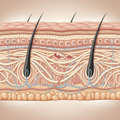
Skin resilience is not one single trait. It comes from four things working together:
- Bounce-back from elastin and its supporting fibers
- Strength from well-organized collagen bundles
- Plumpness and hydration from hyaluronic acid and similar molecules
- Smart repair by fibroblasts that sense tension and rebuild the skin’s support network
Aging weakens all four. The main problem is a vicious cycle in the deeper layer of the skin (the dermis).
Young skin vs. aging skin

In young skin, fibroblasts attach firmly to healthy collagen. They spread out, create gentle tension, and respond by making more of the skin’s support matrix. At the same time they keep collagen-breaking enzymes low.
As we age, collagen fibers break into smaller pieces. Fibroblasts can no longer spread out or generate the same tension. They collapse into an “aged” state. In this state they make less new support matrix, release more breaking-down enzymes, and send out inflammatory signals. Broken collagen leads to weaker fibroblasts, which leads to even more broken collagen. The cycle feeds itself and leaves skin thinner and more fragile.
How cellular signalling, lipids, and blood sugar fit in

Fibroblasts rely on clear cellular signalling to stay healthy. They sense mechanical tension through special receptors on their surface and turn that information into instructions: “make more matrix” or “repair damage.” When collagen is fragmented, those signals get scrambled. The cells receive the wrong messages and shift into the aged, inflammatory mode.
Healthy lipid profiles help keep this signalling working. Cell membranes are made of lipids. When the balance of fats in those membranes is good, receptors function properly and messages travel clearly. Oxidized or imbalanced lipids disrupt the membranes, weaken signalling, and add to low-grade inflammation.
Blood-sugar spikes create another major problem:
Another thing that develops over time is Advanced Glycation End-products, or AGEs. Extra sugar in the blood attaches to collagen and elastin, forming stiff, brittle cross-links. These damaged proteins are harder for fibroblasts to grip. AGEs also bind to receptors that trigger more inflammatory signals. The result speeds up the same vicious cycle — more fragmentation, more aged fibroblasts, more stiffening, and less repair.
What this means for you

Protecting collagen, supporting healthy fibroblast signalling, keeping lipid membranes in good shape, and limiting repeated blood-sugar spikes all work on the same core problem. Steady habits around protein, healthy fats, balanced meals, and ingredients that calm inflammation give your skin’s repair system a better chance to stay resilient.
Approximate Age-group Tipping Points
These are inflection windows, not hard biological cutoffs. They vary by sex, stress-levels, sleep quality, lifetime sun exposure, and how much glycation load (from blood-sugar spikes) the skin has carried. And of course, by the bio-compatible quality of skincare.
Teens to 20s
Collagen and elastic fibers reach peak maturity. Mechanical strength and bounce are at their best until roughly age 30. From the mid-20s onward, though, collagen production begins a slow decline of about 1–1.5 % each year.
Around 30
A clear shift appears. Collagen synthesis starts to fall behind the rate of breakdown. Early changes in the skin’s stress-and-stretch behavior become measurable, and the first detectable alterations show up in elastic fibers. Many women notice wrinkles becoming obvious in this decade.
In the 40s and 50s
The support network’s decline becomes clinically visible. Fibroblast activity, hydration, fat support, and recoil all drop. Fine lines deepen. Interestingly, skin can keep much of its thickness and stretchability into later decades, yet elasticity and recovery capacity fall earlier. Biomechanical tests show a marked drop in elasticity across the 40–60 range.
Perimenopause and menopause (roughly 45–55)
This is often the most meaningful tipping point for women—more so than any single chronological decade. Falling estrogen reduces fibroblast collagen production, weakens key repair signals, and raises the activity of collagen-breaking enzymes. Women can lose up to 30% of dermal collagen in the first five years after menopause, then continue losing roughly 2 % of collagen and 1 % of thickness each year. This loss tracks more closely with postmenopausal time than with calendar age.
60s and beyond Thinning accelerates.
Blood-vessel support declines and immune surveillance and wound healing slow. Skin thickness, which stayed fairly steady from the 20s into the 60s or 70s, now drops more sharply.
70s–80s+
Elastic fibers undergo widespread disintegration. Reserve capacity, barrier recovery, and the underlying fat cushion are markedly reduced. The skin becomes frail, easily torn, and prone to purpura (easy bruising).
What this means for you
The same levers that protect the fibroblast–collagen cycle — steady blood sugar, healthy membrane lipids, clear cellular signalling, and consistent support for collagen and elastin — all remain useful at every stage. Knowing the typical windows simply helps you match intensity of care to the biology that is changing the most right now.
To maintain resilience, the daily use of quality, bio-concordant skincare becomes more important with age. But waiting until ageing damage is very evident is also a bad plan.
Mabel Gray Intensive Hydration Moisturiser treats dryness as more than a shortage of water or hyaluronic acid. It supports the lipid-rich environment the stratum corneum needs to organise an effective, resilient barrier. Because healthy barrier function depends upon a coordinated architecture, not one fashionable ingredient acting alone. The formula combines sustained hydration with compatible emollient lipids that help maintain softness, flexibility and moisture retention. Regular use supports the skin’s own capacity to recover from daily cleansing, climate, friction, and environmental stress and daily challenges.
And over time, protecting this architecture helps preserve the conditions in which skin can function well, communicate effectively and retain its natural longevity resilience.
Mabel Gray creates bio-concordant formulations, not products designed to override the skin, but 'living' combinations of bio-actives, botanicals, and humectants, all selected to work in concert with skin's native lipid architecture and biological intelligence.
Because your skin hasn't forgotten how it used to feel.